Warmian-Masurian Voivodeship · Poland

A ship sails.Across the land.

Between Elbląg and Ostróda, boats cross lakes, locks and five inclined planes. Nineteenth-century water power still moves complete vessels over railway tracks.

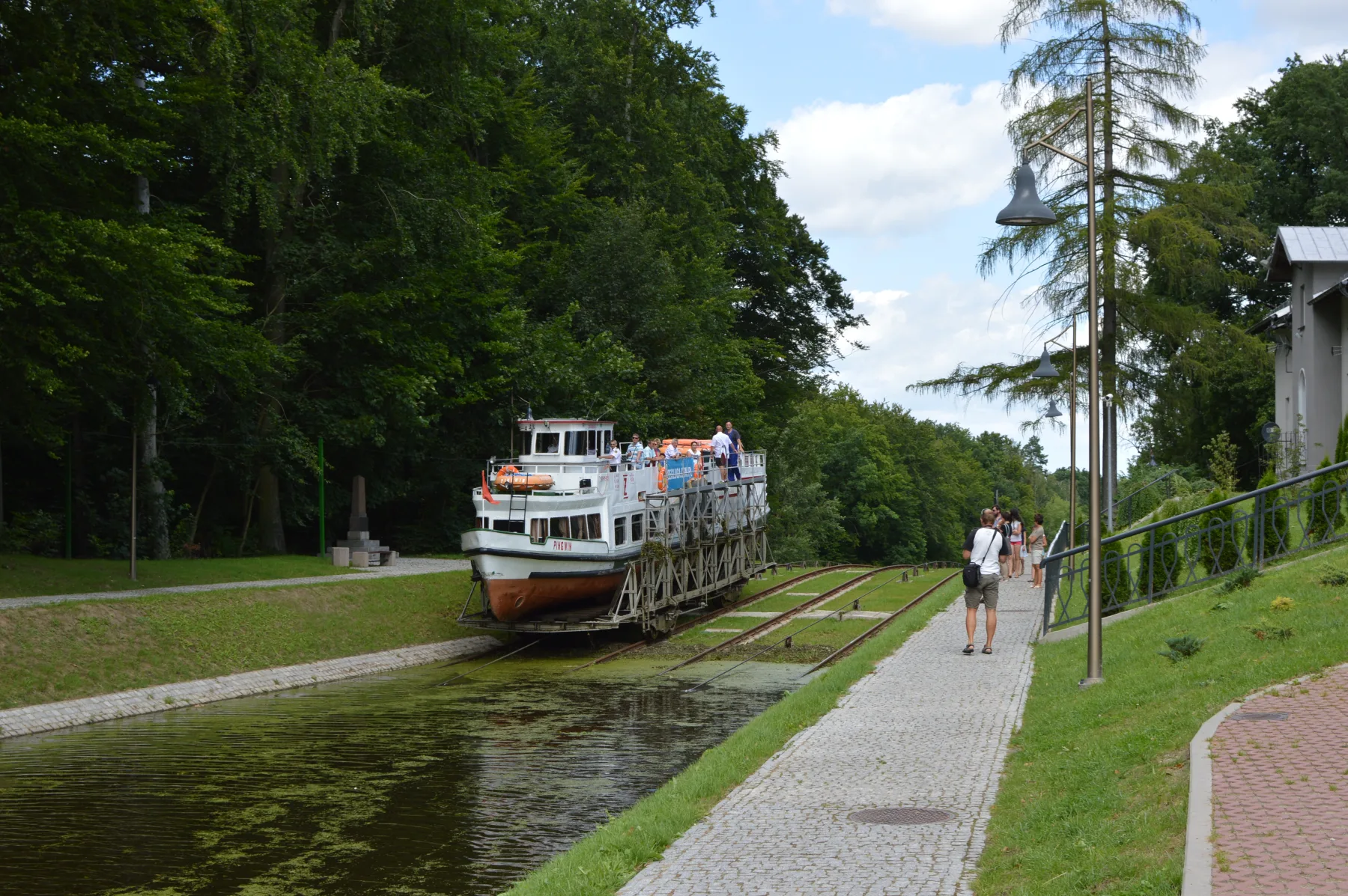
A passenger ship carried on a lattice carriage on the Buczyniec inclined plane
A real passenger ship on the Buczyniec carriageWojciech Pędzich · CC BY 3.0
84.2 km
navigable route
5
historic inclined planes
99.5 m
combined level difference
Verified practical information

Know what is operating before you set off.

The navigation season and opening hours below come from the waterway authority. A newer navigation notice can temporarily change them.

Choose the scale of the journey

Two hours, half a day or the whole canal.

Cruises are linear journeys. Check where the boat starts, how the return bus works and whether you need to reach Jelenie independently.

01A clear first encounter

Four inclined planes

Buczyniec to Jelenie. The shortest route that still lets you experience the full land-transfer cycle several times.

Cruise time
≈ 2 h
Hydraulic structures
4
Approx. return transfer
≈ 20 min
Availability
Daily during the navigation season
See timetable and tickets
02The signature experience

Boat across the grass

Buczyniec and Elbląg connected by all five inclined planes and the reed-lined Lake Drużno.

Cruise time
≈ 4½ h
Hydraulic structures
5
Approx. return transfer
≈ 45 min
Availability
Daily during the navigation season
See timetable and tickets
03For dedicated canal travellers

The complete axis

Ostróda to Elbląg: lakes, two locks, five inclined planes and more than eleven hours on the historic waterway.

Cruise time
≈ 11 h
Hydraulic structures
5 + 2 śluzy
Approx. return transfer
≈ 60 min
Availability
Selected monthly dates in 2026
See timetable and tickets
Elbląg → Ostróda

One canal. Seven changing landscapes.

The route is not a single trench. A cruise moves from an urban river into a bird reserve, over dry hills, through forest lakes and finally across two locks.

Open the detailed interactive map →
  1. 01Elblągriver and old town
  2. 02Lake Drużnoreed reserve
  3. 03CałunyFrancis turbine
  4. 04Jelenieinclined plane
  5. 05Oleśnicalargest drop
  6. 06Kątyinclined plane
  7. 07Buczyniecvisitor centre
  8. 08Miłomłynlocks and junction
  9. 09OstródaLake Drwęckie
The real mechanism

Not a crane. A coordinated transport machine.

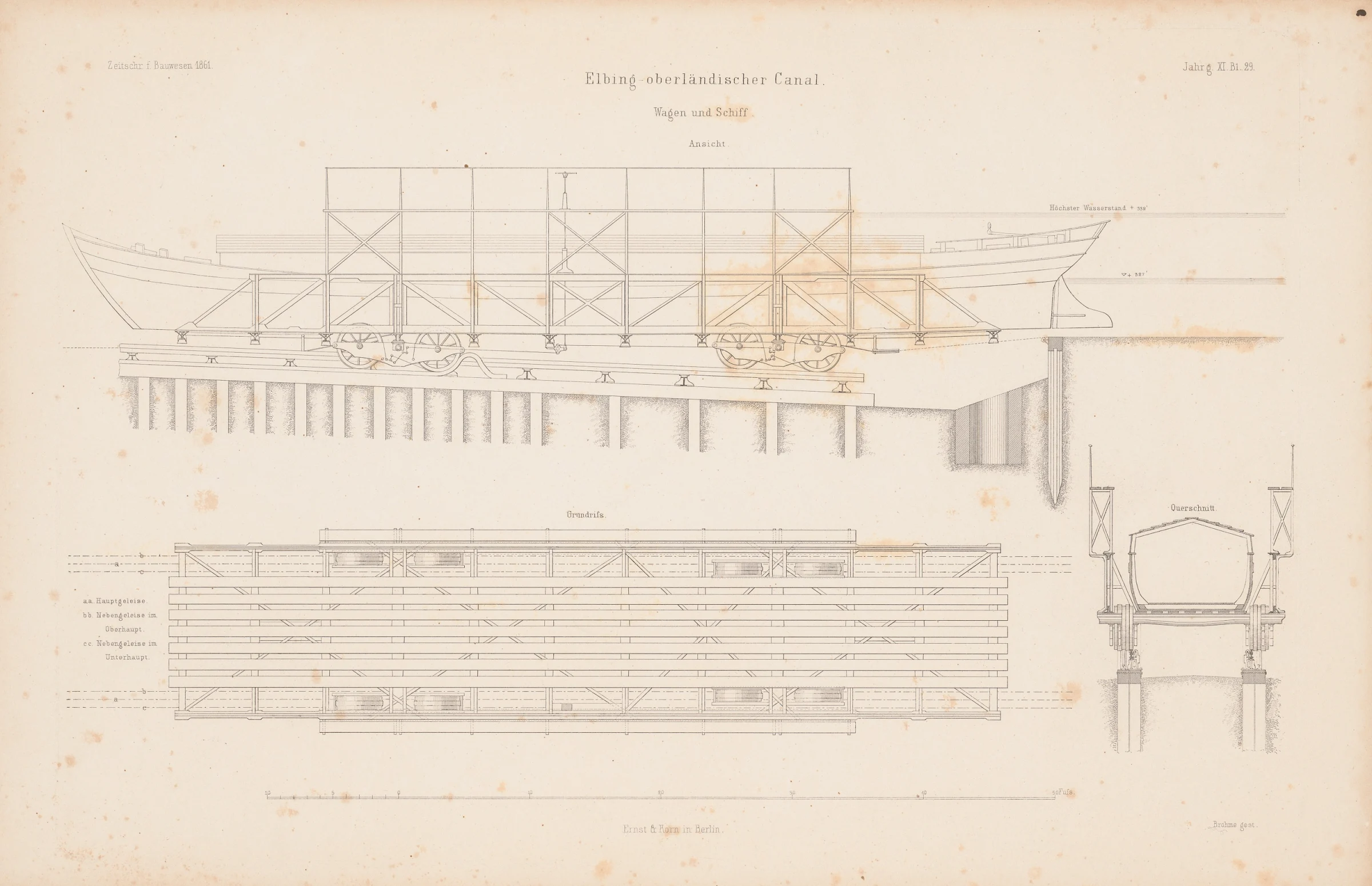
A vessel remains afloat until it settles over a submerged railway carriage. The carriage supports the hull and then crosses the hill on rails.

Historic technical plate showing a vessel supported by the wheeled carriage of an Elbląg Canal inclined plane
Original technical plate · 1861Deutsche Digitale Bibliothek
  1. 01

    Enter on water

    The carriage waits below the surface. The boat moves between its side frames without being lifted by a crane.

  2. 02

    Settle on the carriage

    As the rails rise, the hull is supported by the carriage structure and leaves the water together with it.

  3. 03

    Travel on rails

    Steel cables connect the carriages to the hauling machinery. One carriage rises while the other moves in the opposite direction.

  4. 04

    Use water as power

    Four inclined planes use a water wheel. Całuny, completed later, uses a Francis turbine.

Five structures, five exact profiles

Explore the full Polish technical atlas →
Five structures, five exact profiles
Inclined planeTrack lengthLevel differenceDrive
Buczyniec490,30 m20,62 mwater wheel
Kąty404,00 m18,88 mwater wheel
Oleśnica479,00 m24,20 mwater wheel
Jelenie433,00 m21,99 mwater wheel
Całuny352,00 m13,83 mFrancis turbine
Sources and responsibility

Useful facts should be traceable.

This is an independent educational guide. Dimensions and operating information are linked to their sources; seasonal details should always be confirmed immediately before travel.